

CODEX MORTIS Launches on Steam Early Access as First Fully AI-Made Game
Bullet hell meets Guild Wars-style build crafting in this experimental release

AI Development Meets Bullet Hell#
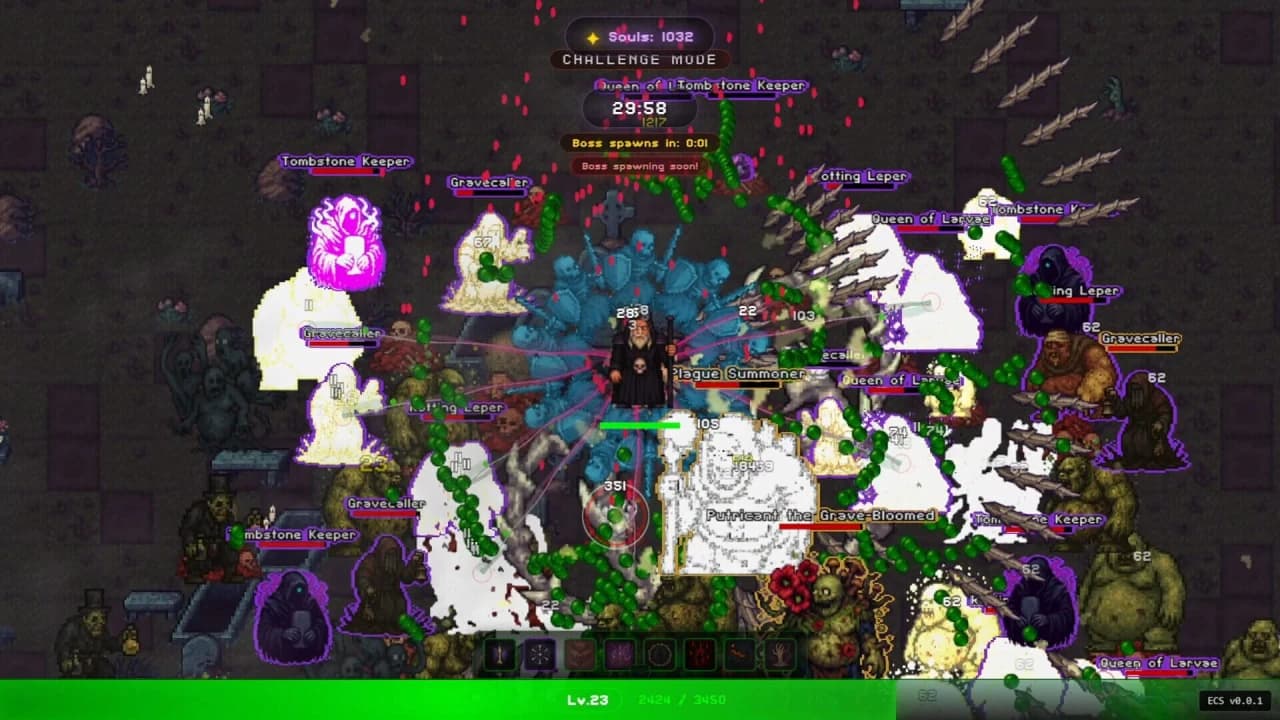
According to Games Press, CODEX MORTIS has launched into Steam Early Access as the first fully AI-developed game. The title combines the bullet hell survival mechanics of Vampire Survivors with the deep build-crafting systems found in Guild Wars.
The game is already gaining traction on Steam following its Early Access debut. Players navigate waves of enemies while experimenting with different skill combinations and build strategies, borrowing heavily from the addictive loop that made Vampire Survivors a breakout hit in 2022. That formula - survive, level up, become absurdly overpowered, repeat - proved that auto-battlers could work outside the mobile space, and CODEX MORTIS is betting that same audience is hungry for more complexity.
The Vampire Survivors comparison is significant because that game redefined what a $3 indie title could achieve. It dominated Steam's top sellers for months and spawned countless imitators. CODEX MORTIS enters a crowded field of survivors-likes, but the Guild Wars angle might be its differentiator in a genre that's becoming saturated with clones.
What Sets It Apart#
Beyond its AI development angle, CODEX MORTIS leans into Guild Wars-inspired customization. This means players can expect more deliberate build planning compared to the typical auto-battler formula. The combination aims to satisfy both fans of frantic action and those who enjoy theorycrafting optimal character loadouts.
For context, Guild Wars built its reputation on a skill system where players selected 8 abilities from hundreds of options, creating distinct builds for different scenarios. If CODEX MORTIS captures even a fraction of that depth, it could appeal to the theorycrafting crowd who felt Vampire Survivors was too random or shallow. The question is whether that added complexity enhances the dopamine-driven gameplay loop or bogs it down with decision paralysis.
The Early Access launch gives the developers a chance to gather player feedback and refine the experience. As with most Early Access titles, expect ongoing updates and balance changes as the community digs into the mechanics. This is especially crucial for a game leaning on build diversity - if certain combinations are clearly superior, the meta will solidify quickly and undermine the whole customization premise. Games like Hades and Risk of Rain 2 showed that constant iteration during Early Access can turn good roguelikes into genre-defining ones.
Early Access also serves as a proving ground for the AI development claim. Players will scrutinize every system, every balance decision, every UI quirk. If the game feels unpolished or poorly designed, the AI angle shifts from novelty to liability. If it's genuinely fun and well-crafted, it becomes a case study.
A New Development Frontier#
While AI-assisted tools have become common in game development - from procedural generation to automated testing - CODEX MORTIS positions itself as fully AI-made. This raises questions about the future of game creation and what role AI might play in indie development going forward.
The claim of being "fully AI-developed" is bold and somewhat ambiguous. Does that mean AI generated the code, the art, the game design, the balance tuning? Or did humans provide direction while AI handled implementation? The distinction matters, especially as the industry grapples with AI's role in creative work. Some developers see AI as a democratizing force that lets small teams punch above their weight. Others worry it devalues human craft and floods the market with low-effort content.
For solo developers and tiny studios, AI tools could theoretically level the playing field against larger teams. If CODEX MORTIS delivers a polished experience, it might inspire a wave of AI-assisted indie projects. If it feels soulless or derivative, it could reinforce skepticism about AI's creative limitations.
The gaming community's reaction will likely be mixed. Some players won't care how a game was made if it's fun. Others will view AI development as a novelty at best or a gimmick at worst. And there's a subset who will avoid it on principle, seeing AI-generated content as antithetical to the artistry they value in games.
CODEX MORTIS is available now on Steam Early Access. Will you be checking out this AI-developed experiment, or does the concept leave you skeptical? Either way, it's a milestone worth watching as the industry figures out where AI fits in game creation.