

Stop Killing Games Campaign Fails to Secure EU Legislation
Petition with 1.3 million signatures falls short of forcing publisher accountability
Campaign Falls Short Despite Massive Support#
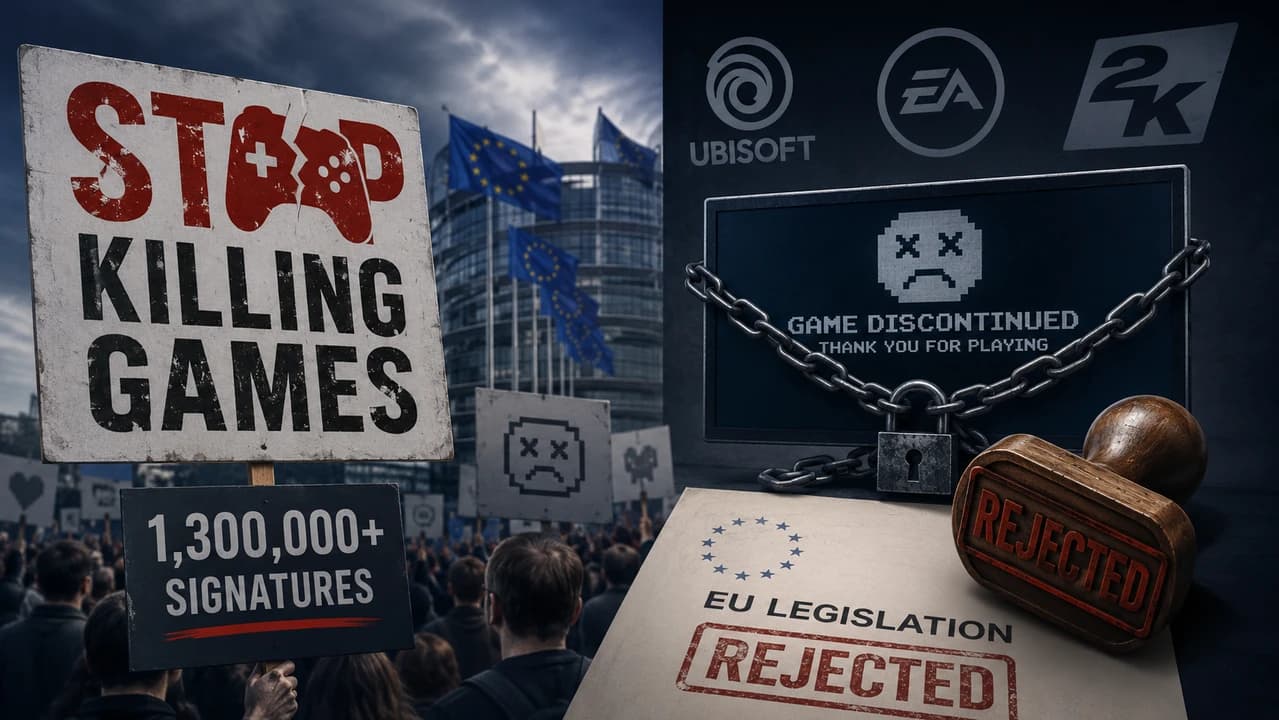
The Stop Killing Games campaign has failed to secure EU legislation despite gathering over 1.3 million signatures. The initiative sought to require publishers to keep discontinued games playable after official support ends, but EU regulators ultimately declined to move forward with new laws.
The campaign gained significant momentum following high-profile game shutdowns that left players unable to access titles they had purchased. The closure of games like The Crew - where Ubisoft not only shut down servers but remotely deactivated the game entirely, making it non-playable even in single-player - became a rallying point for the movement. Supporters argued that when publishers discontinue online games or services, consumers lose access to products they paid for, raising serious questions about digital ownership and consumer rights.
What This Means for Players#
The regulatory decision means publishers will continue operating under current frameworks when shutting down game servers or discontinuing support. There will be no legal requirement to provide offline modes, release server software, or ensure games remain playable after end-of-life announcements.
In practice, this leaves players in a familiar but frustrating position. You can spend $60 or more on a live-service title, invest hundreds of hours into it, and have zero legal recourse when the publisher decides to pull the plug. The game simply stops existing. Your purchase history says you own it; your library says otherwise.
The campaign's core ask was actually fairly measured - it wasn't demanding publishers run servers forever, just that they leave games in a functional state when walking away. Options like releasing server emulation tools, enabling LAN play, or stripping out the always-online requirement were all on the table as potential solutions. The fact that even this baseline standard couldn't gain regulatory traction is a significant setback.
While the campaign did not achieve its primary legislative goal, it brought substantial attention to the issue of game preservation and digital ownership. The 1.3 million signatures demonstrated clear community concern, and that kind of organized pressure rarely disappears quietly - it tends to resurface the next time a beloved title gets the shutdown notice.
The Broader Conversation#
The Stop Killing Games initiative highlighted ongoing tensions between publisher business models and consumer expectations in an increasingly digital gaming landscape. The shift away from physical media has quietly eroded the concept of ownership for a generation of players. Older gamers remember a time when buying a game meant owning it unconditionally - no servers required, no license agreements that could be revoked. That's increasingly not the reality.
Without regulatory intervention, the responsibility for game preservation remains largely with publishers themselves. Some have handled this well: games like City of Heroes saw their source code eventually leak, spawning a thriving private server community. Others have actively pursued legal action against preservation efforts, treating fan-run servers as threats rather than lifelines.
The broader preservation community - including organizations like the Video Game History Foundation - continues to document just how much of gaming history is already lost or at serious risk. The Stop Killing Games campaign was one front in a much larger fight.